Foresight and Afterimage
Solo exhibition at Cable Depot, London. June - July 2024
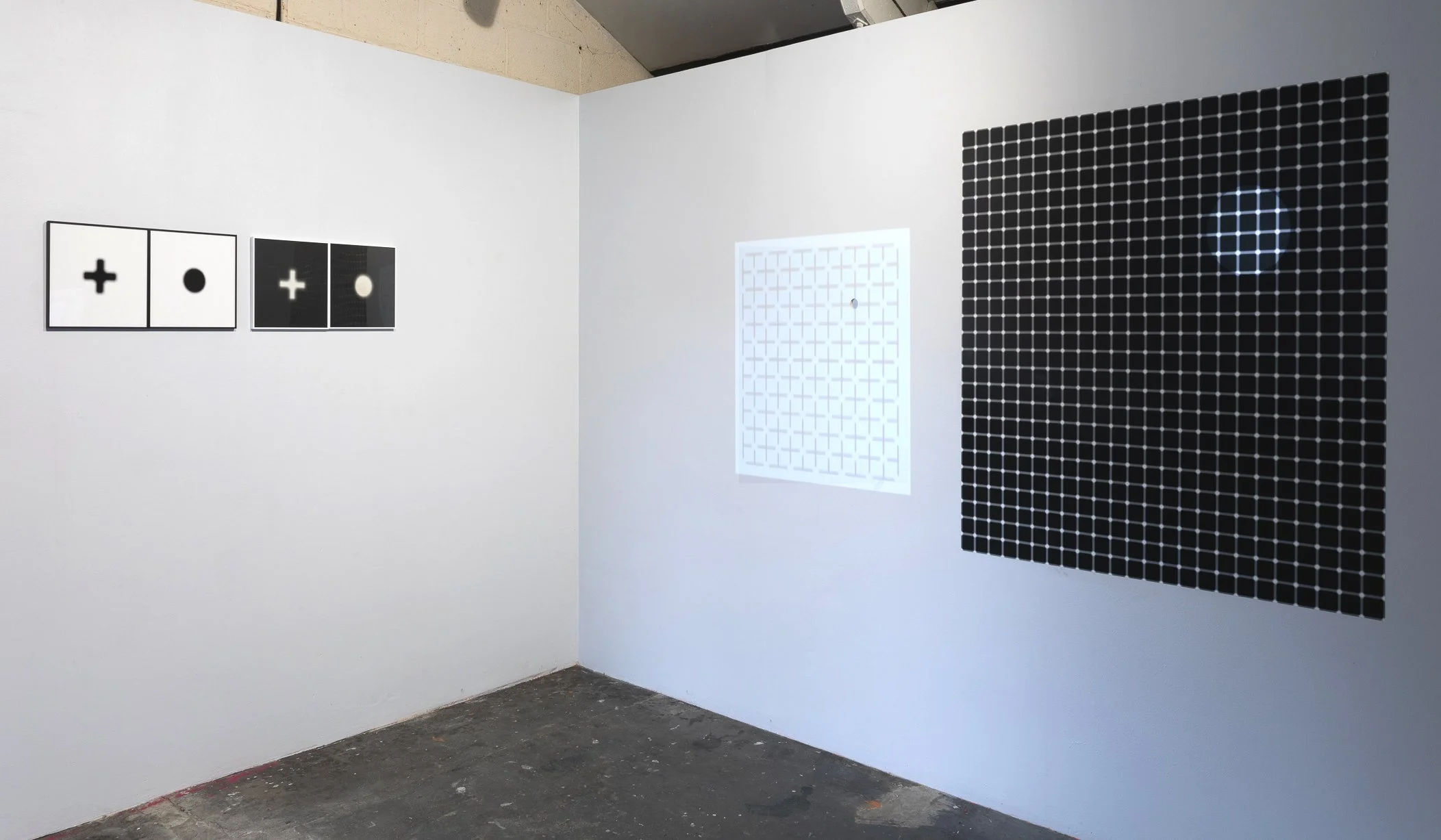
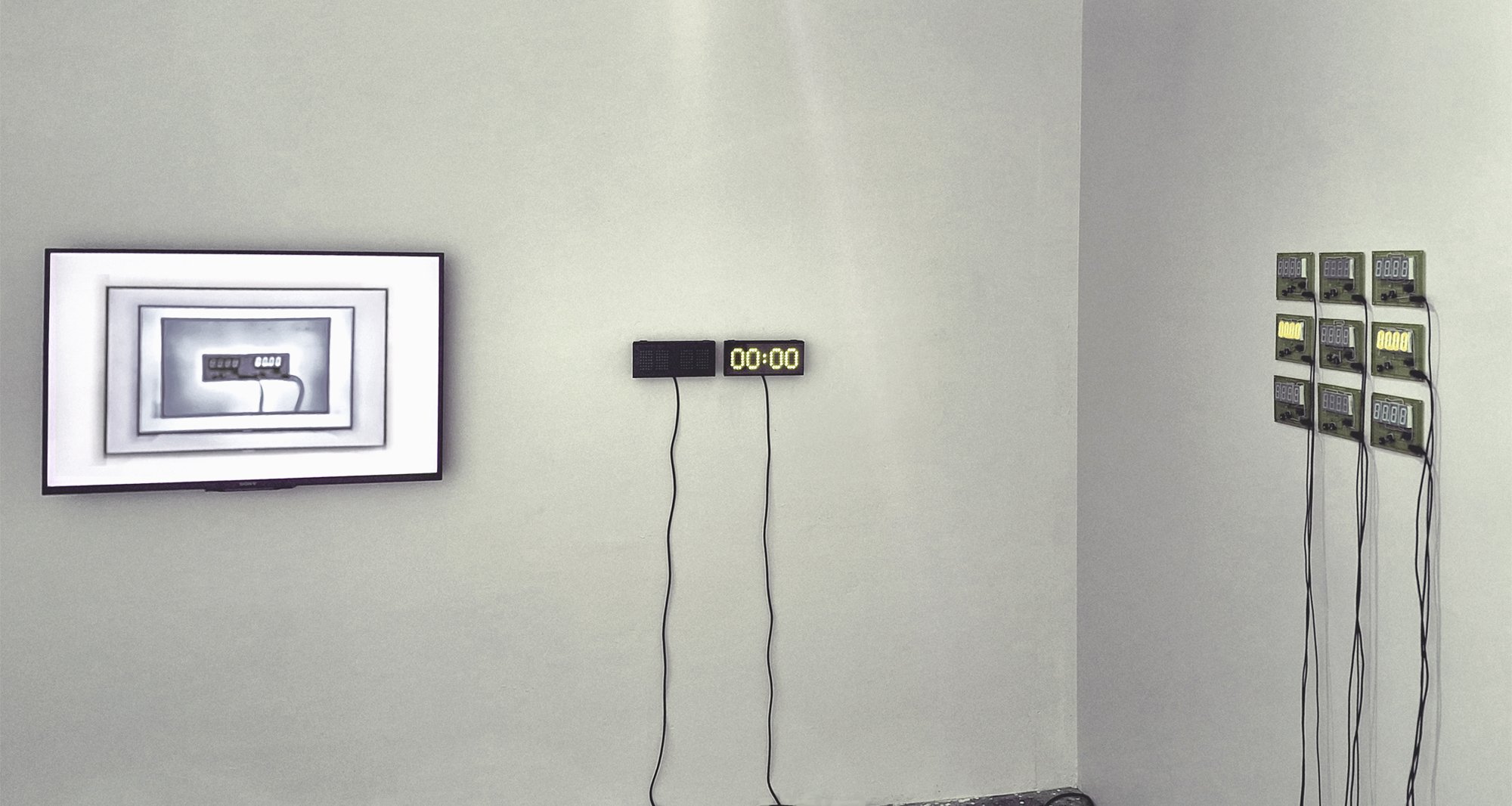
Exhibited works
Blind Spot. Version-Inversion, 2024.
Four framed photograms
Intentionalities (Occlusion #6), 2024.
Digital projection, digital print, gobo light, peephole, cctv camera and monitor
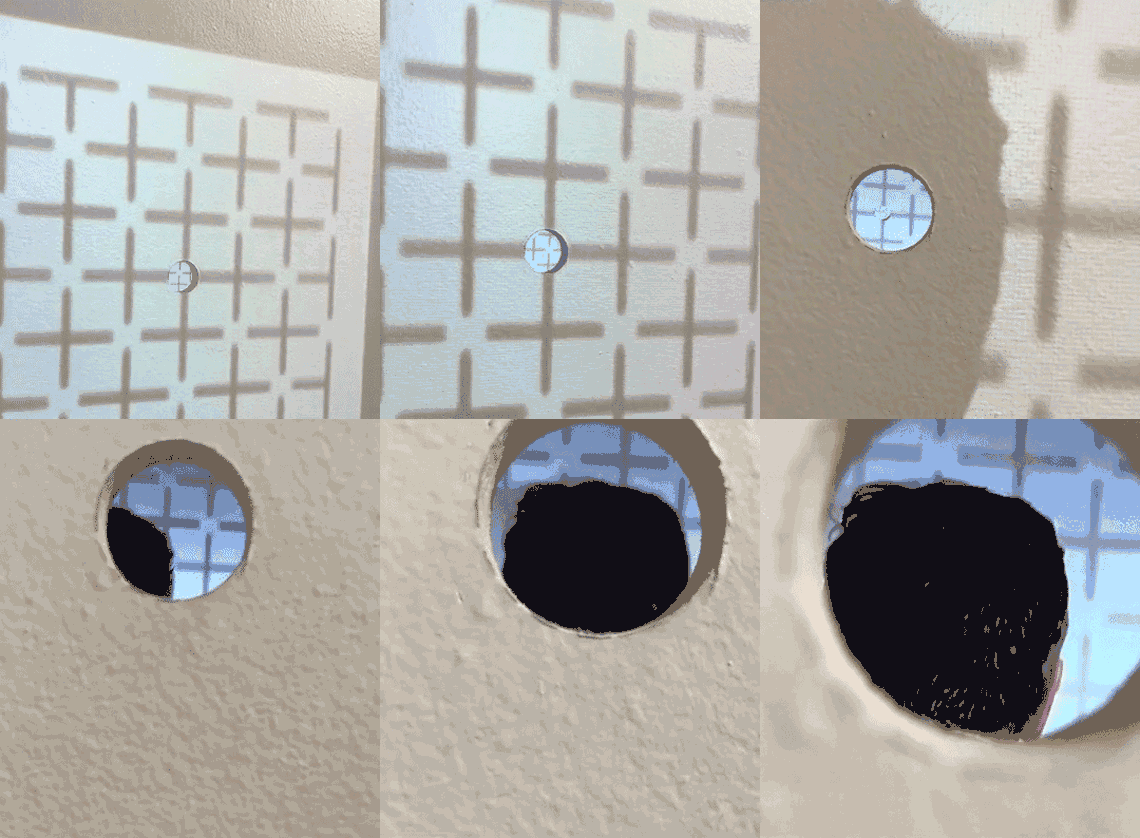
Regress, 2024.
Video loop, 45 mins, colour, silent
In Two Minds, 2024.
Two LED clocks, re-programmed to display ‘00:00’ flashing at slightly different intervals
Edge of Motion #7, 2024
Nine LED clocks, re-programmed to display ‘00:00’ flashing at slightly different intervals
Photos by Josef Konczak
This is the time, and this is the record of the time ¹
Steven Scott
Part 1. Seeing ahead
Might there be hidden, secret, rhythms, hence inaccessible movements and temporalities? ²
Rhythmic patterns and iterations can evolve out of the alignments and occlusions we witness every day as we move through the world. Walking through a city our footsteps punctuate a changing viewpoint and measure the shifting parallaxes of brick, concrete and glass in units of time that dissipate in space. From a moving vehicle the landscape is made up of arrays of buildings, trees, and open space in which closer objects obscure and reveal those distant. The movement of these layers conflate our agency with a tacit awareness of relativity between the timelines of the foreground, middle and far distance. To traverse these patterns of disappearance and return requires a form of ‘seeing ahead’ in which we estimate their rhythmic timings, velocities, trajectories, and possibilities out of current circumstances.
Parallax effect and phase shift
The phenomena of phase shifting can be perceived in patterns of alternation and alignment that form between adjacent rhythmic events. In watching such patterns evolve and dissolve we might imagine, perhaps in vain, that a meta-cycle of complete synchronisation will eventually take place, and we will witness an otherwise hidden system of behaviours.
Phase shift is most readily associated with the techniques of musical composition developed by Steve Reich in which serial refrains for two or more instruments, voices or recordings are designed to slip in and out of unison in simple patterns of chance. The effectiveness of this as a compositional technique relies on this slipping of one pattern – refrain or rhythm – against another to form new structural/musical relationships. Reich’s early tape-based phase pieces such as ‘It’s Gonna Rain’ (1965) and ‘Come Out’ (1966) consisted of pre-recorded sounds or electronic pulses that were doubled and designed to slip out of synchronisation in echoing, repeating patterns that had rhythmic effect.³
Reich developed these early experiments with chance into complex multi-layered works using live instrumentation in repeating permutation cycles. As an adjunct to his musical compositions in the early 1970s he briefly explored image phasing with the use of looped video recordings of subjects speaking short phrases. These were copied and played back on three or more monitors so that the subtle differences in the timing of each recording multiplied into phasing layers of sound and image.
In order to explore phasing as a visual phenomenon rhythmic sound can be transposed into a sequence of image events or patterns of movement. Translating the intervals marked by the ticking sound of a clock into the flashing on-and-off of its illuminated digits offers a schematic representation of time by spatialising it as a flow of discrete visual units. And when many such clocks are situated together the fractions of difference between the iterations of their appearing and disappearing digits becomes a system of shifting interplays. These units do not accumulate as time measured in hours, minutes and seconds, but instead dissipate as positions in space. This process quickly becomes difficult to assimilate as our attention to visual difference struggles to separate the regularity of the digits’ repetitions in time from the shifting pulses that mark their spatial relationships. This moment-to-moment stutter and delay divides and dissipates time into multiple units that begin to describe a spatial array rather than a durational flow. Because the clock digits repeat rather than measure passing time, any search for order - and by implication meaning – in the form of a possible realignment of the light pulses, lies beyond the scope of accurate predictability. Instead, there remains a sense of instability as the digits’ disappearing and reappearing form degrees of alignment that confound calculation.
Phasing as possibility
Phasing patterns, whether auditory or visual, can be perceived in the fluctuations of difference between adjacent events playing out in real time. Once a pattern of slipping between synchronisation and counterpoint is recognised there comes the assumption that such concurrencies in time, multiplied by positions in space, will occasionally coincide and the zeros all briefly realign, before slipping back into chaos. But without precise measurement of the timings of these events there is no way to calculate any future phases of synchronisation. We can only assume that such realignments are possible and so acknowledge that an aspect of the phenomena remains beyond a perceptual threshold. In this way phasing retains a pertinence, by offering the ongoing possibility of realignment in a process that conflates the immediacy of vision with the ability to visualise.
To perceive phasing in the interference patterns of visual rhythms also implies a seeing ahead, and imagining the appearance, however fleeting, of full alignment and order out of chaos. This in turn allows us to liken phasing to a condition of becoming that describes a span between possibility as assumption, and probability as protention.
Part 2. Seeing behind
Rhythm and reflexivity
Time-flow is both the piling up of and the subsequent differentiation of one rhythm and the next.⁴
Rosalind Krauss, in writing about the flickering image loop of a zoetrope – a spinning cylinder with slits that alternate with a succession of images of movement on its inner surface – describes an experience of a movement-stasis impasse perceivable between the animated image and its means of presentation. The illusion of a moving subject can be seen at the same time as one is aware of experiencing this as a visual effect: ‘…uniting the experience of both inside and outside is the beat or pulse that courses through the zootropic field…both constructing the gestalt and undoing it at the same time – both positioning us within the scene of its active viewer and outside as its passive witness.’⁵ Such a doubling of consciousness, seeing the moving image as effect and ourselves as witness to this effect, might result in the perception of such repetitions as time dividing into units in space and held in a deadlock by the static counterpoint of meta-awareness, as a series of images that are both points in time and positions in space, according to their velocity. This condition of awareness – seeing an illusion as an illusion – requires a doubled position within which visual rhythms are both a subjective experience and a schematic description of pattern and effect.
This reflexive experience of rhythm and repetition, and its relationship to being ‘present’ in perception has been a consideration in the work of practitioners in different fields. Film maker Peter Kubelka described the intention behind his seminal flicker film Arnulf Rainer (1960) was to enable the viewer, ‘To perceive film not as motion but as a quick succession of static units. Arnulf Rainer developed out of a longing for the ‘now’-experience.’ The film consisted of six and a half minutes of modulated flickering light, with accompanying sections of abstract sound, made from arrangements of clear and black frames that were intended to highlight a viewer’s awareness of being in the moment rather than of a represented subject. Whether film frames or rhythms of pulsing light, such flickering may be seen by some as a mesmerising fusion of temporality and stasis, of time becoming spatialised. But velocity or flicker rate can render it an uncomfortable experience that demarks the edge of our capability for assimilation, revealing the threshold of what we see as separate and recognise as difference between rhythmic units as they play out over time and in space.⁶
The Memory-Image
In proposing that an awareness of ourselves in the world is constituted both in and of time in relation to space Henri Bergson outlines how we must continually process a notional interior time as simultaneous space to be able to determine it in a form of measurable change. He determines that consciousness cannot divide time and locate specific moments as separate from each other subjectively, but instead consciousness becomes aware of time as a result of it’s becoming multiple and successive in space, so that space consists of events that correspond to time as points of difference.
In Time and Free Will Bergson uses the example of an analogue clock to describe a notional relationship between internal time flow – as pure-duration – and the perception of spatialised events that constitute the external world in its conjunctions with consciousness. ‘When I follow my eyes on the dial of a clock the movement of the hand which corresponds to the oscillations of the pendulum, I do not measure duration…I merely count simultaneities, which is very different.’⁷ In relation to this Bergson proposes what he calls the memory-image, ie the moment which has not yet passed from memory, as it fuses the immediate past in oscillations with a tacit self-awareness that constitutes the present. ‘Outside of me, in space, there is never more than a single position of the hand and the pendulum, for nothing is left of the past positions. Within myself a process of organisation or interpretation of conscious states is going on, which constitutes true duration. It is because I endure this way that I picture to myself what I call the past oscillations of the pendulum at the same time that I perceive the present oscillation’⁸ It is this proposed concurrency of the present and its immediate and persisting past, as memory-image, that we might determine resonates with the experience of phasing, as a process of apprehension that is plural, a melding of self and the world as constituting spatial and temporal difference.
In considering the interplay of rhythms that constitutes phase shifting Bergson’s notional memory-image is a useful model for considering the assimilation of concurrent states of possibility and probability inherent in phasing cycles, particularly in reference to the velocity of that which is passing and that which is still ‘taking place’. We might also consider the memory-image in relation to the doubling and layering of awareness whereby passing image events – time as successive spatial differences – can be projected in the form of expectation of further degrees of difference. This interpretation of Bergson offers a notion of the immediate past persisting as the fluctuation of patterns that allude to possible outcomes, but are yet to become probable, much less actual. Ultimately we might determine a relationship between inter-flow and intra-flow and a resultant pluralised awareness, as we are reminded of ourselves as implicit in the process of perception.
The Image of Memory
Interpreting the concurrencies and misalignments of events as a cohesive system is not quite the same as seeing a sequence of moments demarked by positions. We perceive phasing in the multiple patterns of repetition and position as they alternate at different velocities, experiencing these as layered polyrhythms that seem to intersect through and between each other in an ever-changing whole. In such cases phasing is a perceptual phenomenon that describes not just what is taking place now, but also speaks to our means of apprehending the world by referring us back to ourselves, suggesting that we don’t just observe phenomena objectively but calculate previous patterns of behaviour in a search for possible outcomes. And inherent in our apprehension of the intra-flows that constitute phasing there will remain gaps, delays and counter-flows that impinge on our focus and afford us a glimpse of ourselves; not so much seeing and knowing what we are seeing, as seeing and knowing that we are seeing.
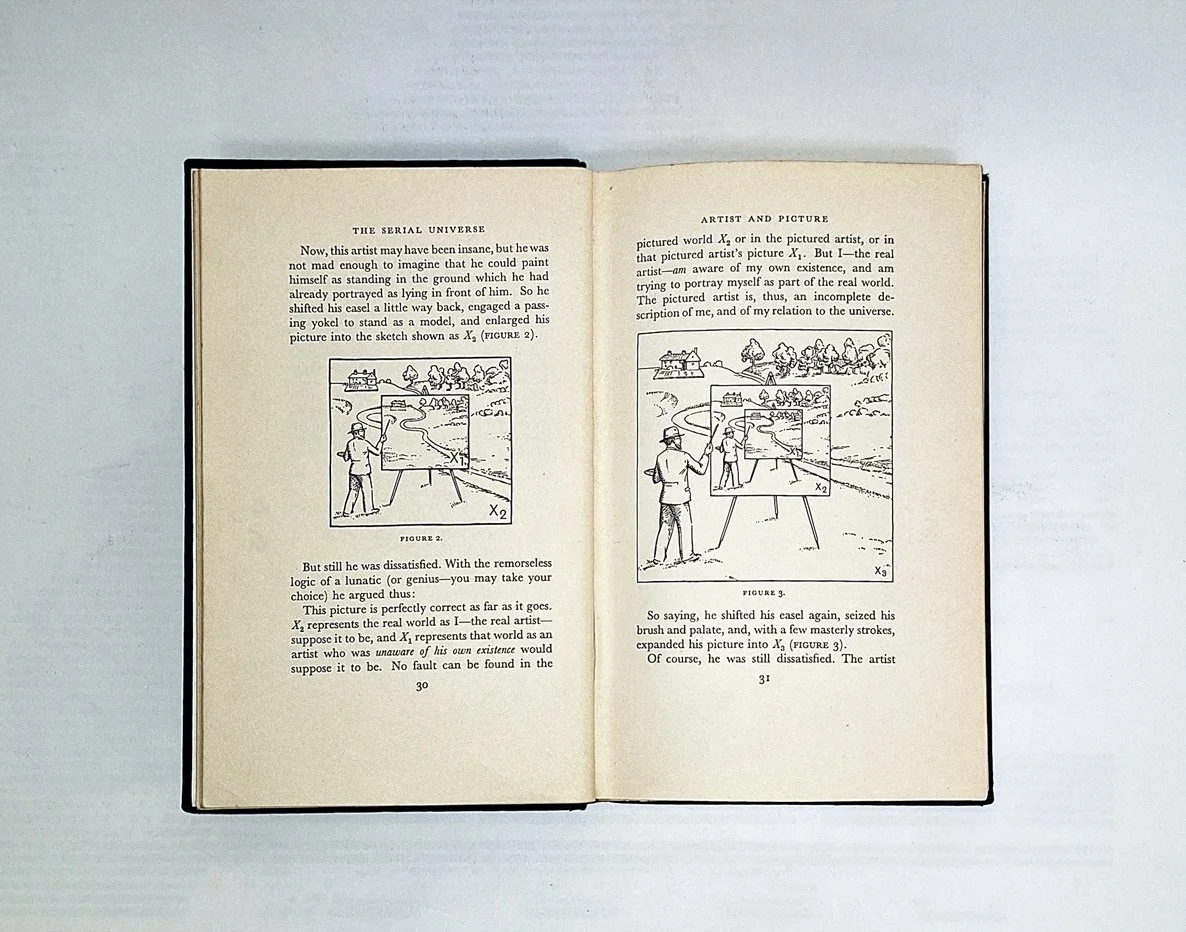
‘…the first essential for any science which can satisfy us as fitting the facts of experience is that it shall employ some method of description which is suitably regressive’
JW Dunne, The Serial Universe, (Faber and Faber, London, 1934) p34
©Steven Scott, 2024
Written to accompany the exhibition ‘Foresight and Afterimage’ by Steven Scott.
At Cable Depot, London. June – July 2024
¹ Laurie Anderson, ‘From The Air’, from Big Science, (Warner Bros. Records) 1982
² Henri Lefebvre, Rhythmanalysis. Space, Time and Everyday Life, (Bloomsbury, 2004) p26
³ ‘…I had the idea that if a number of single tones were all pulsing at the same tempo but with gradually shifting phase relations, a great number of musical patterns would result.’ Steve Reich, ‘The Shifting Pulse Gate’ in Writings on Music 1965-2000. (Oxford University Press, 2002) p38
⁴ Jay Lampert, Simultaneity and Delay: A Dialectical Theory of Staggered Time, (Bloomsbury, 2012) p132
⁵ Rosalind Krauss, ‘The Im/pulse to See’ in Vision and Visuality, Hal Foster (Ed.) (Bay Press, 1988) p59-60
⁶ Flickering light is perceived as a visible phenomenon below what is known in the field of Psychophysics (the branch of Psychology concerned with the effects of physical stimulation and the sensory thresholds of the body) as the ‘flicker fusion threshold’, determined to be approximately 16 frames per second (or 6.25 milliseconds). Rates above 16fps are perceived as fusing into a continuous image of movement or colour as a result of the phenomenon commonly known as persistence of vision. This threshold of human perception is subject to the degrees of difference between each individual frame image, how each differs in brightness and contrast, colour and pictorial content, and the environmental conditions in which it is viewed. The lower frames rates of what we might conceivably call flicker are more subjective but rates slower than 4 to 5 frames per second begin to be perceived as a series of individual visual moments in time. George A. Gescheider, Psychophysics: The Fundamentals (London: Psychology Press, 1997) p19
⁷ Henri Bergson, Time and Free Will, (Muirhead Library of Philosophy, London, 1956) p107-108
⁸ Ibid, p108